Danish Superliga · Brøndby, Copenhagen
Brøndby IFDrengene fra Vestegnen
Eleven Danish championships, seven Danish Cups and one of the loudest stands in Scandinavia. This is the club from Copenhagen's western suburbs — the Boys from the Vestegnen.
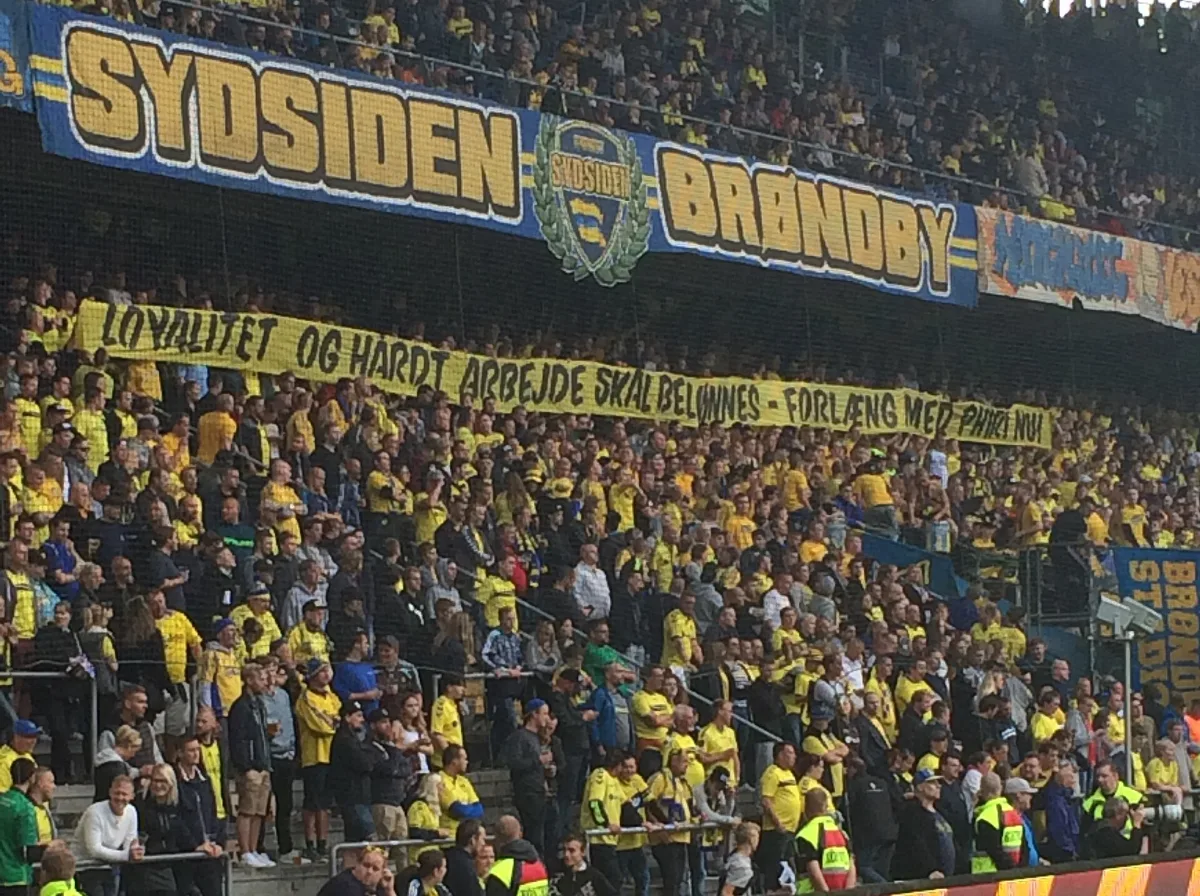
The Sydsiden home end at Brøndby Stadion, beneath its giant BRØNDBY IF banner, on the opening day of the 2016–17 season. Photo: Tøndemageren, CC BY-SA 4.0, via Wikimedia Commons.
The club
A suburb that built a giant
Brøndbyernes Idrætsforening — Brøndby IF for short — was born on 3 December 1964, when two local rivals, Brøndbyøster IF and Brøndbyvester IF, merged. The merger was not romantic: it was the condition Brøndby Municipality set before it would build the new ground the two clubs needed. The new club started in Serie 1, the sixth tier of Danish football.
Fifty-odd years later, Brøndby are one of the two biggest clubs in Denmark. They were the country's first fully professional club (1986), the first to be listed on the Copenhagen Stock Exchange (1987), and the club that produced the likes of Michael Laudrup, Peter Schmeichel, Ebbe Sand and Kim Vilfort.
The identity is regional as much as sporting. Vestegnen — "the western edge" — is the belt of working suburbs west of Copenhagen, and Brøndby has always worn that badge proudly: a suburban club taking on the capital's establishment, first KB and Boldklubben 1903, and since 1992 their merged successor, F.C. København.
“Fællesskab.” Community. It is the value the club put at the centre of its 2016 strategy, and the word that best explains the Faxe Tribunen on a European night.The club's stated core value
Fact file
- Full name
- Brøndbyernes Idrætsforening
- Founded
- 3 December 1964
- Nickname
- Drengene fra Vestegnen
- City
- Brøndby, Copenhagen
- Ground
- Brøndby Stadion
- Capacity
- 28,000
- League
- Danish Superliga
- Colours
- Blue & yellow
- Head coach
- Thomas Nørgaard
- Chairman
- Jan Bech Andersen
- Majority owner
- Global Football Holdings (50.1%)
History
From the sixth tier to the Superliga
Sixty years of promotions, European nights, a near-death financial crisis and a title nobody outside Brøndby saw coming.
-
1964 · The merger
Brøndbyøster IF and Brøndbyvester IF put their rivalry aside to form Brøndbyernes Idrætsforening. The new club's debut season is in Serie 1, the sixth tier.
-
1965 · A home of their own
The new ground opens: little more than a grass pitch ringed by an athletics track, but it is where the club has played ever since.
-
1973 · Bjerregaard and the Laudrups
Club captain Per Bjerregaard, a doctor, becomes chairman at 27 and appoints Finn Laudrup as player-coach. Laudrup brings his two young sons, Michael and Brian, and an attacking philosophy that never really left the club.
-
1981 · 85 goals in 30 games
Brøndby tear through the second tier and win promotion to the top-flight 1st Division under Tom Køhlert.
-
1982 · Michael Laudrup arrives
Still a teenager, Laudrup scores 15 league goals in his first top-flight season, wins Danish Player of the Year, and on 15 June becomes the first Brøndby player to win a national cap. In 1983 he is sold to Juventus for a then-record Danish fee — the money that funds the club's next decade.
-
1985 · Champions at last
Four years after promotion, Brøndby win their first Danish championship, then beat Budapest Honvéd 4–1 in their first ever European tie.
-
1986–87 · Going professional
Brøndby become the first fully professional club in Denmark, signing ten players full-time, and in 1987 the club is listed on the Copenhagen Stock Exchange.
-
1990–91 · The European run
Under Morten Olsen, Brøndby beat Eintracht Frankfurt, Bayer Leverkusen and Torpedo Moscow to reach the UEFA Cup semi-final. A Rudi Völler goal in the 88th minute ends the dream and sends Roma to the final instead. The side still wins a fifth championship in seven seasons in 1991.
-
1992 · Boom and bust
A planned takeover of the bank Interbank collapses after European Cup elimination by Dynamo Kyiv, and the club is left with debts of 400 million DKK. A long rescue plan begins.
-
1995–96 · Rebuilt
Ebbe Skovdahl builds a new side around Lars Olsen, John “Faxe” Jensen, goalkeeper Mogens Krogh and a young striker named Ebbe Sand. Liverpool are knocked out of the UEFA Cup and a first title in five years arrives — the first of three in a row.
-
1996–97 · The Karlsruhe comeback
One of the great European comebacks: 3–1 down at home to Karlsruher SC, Brøndby win 5–0 away in Germany to go through.
-
1997–98 · The Double
A third straight championship plus the Danish Cup. The following season brings Champions League football, played at rivals' Parken while Brøndby Stadion is rebuilt.
-
2000 · The new stadium
The rebuilt ground opens and 28,416 spectators watch a 4–2 win over AB. Capacity is now around 29,000 — second only to Parken.
-
2001–02 · Kids and goal difference
Youth coach Tom Køhlert, reluctant but in charge, hands debuts to the academy — most famously Thomas Kahlenberg — and Brøndby nick the title on goal difference.
-
2004–05 · Double again
A league and cup double, including a record 7–0 win over Herfølge.
-
2013–14 · Saved
Again close to bankruptcy, the club is rescued by a group of local investors. In April 2014 Jan Bech Andersen takes over as chairman.
-
2016 · Overfaldsfodbold
Strategi 6.4 puts community at the club's heart. German coach Alexander Zorniger brings extreme gegenpressing — nicknamed overfaldsfodbold, “assault football” — and two runners-up finishes follow, along with the 2018 Danish Cup.
-
24 May 2021 · Champions again
A 2–0 win over Nordsjælland seals Brøndby's 11th Danish championship — their first in 16 years — finishing ahead of Midtjylland and arch-rivals F.C. København. Niels Frederiksen's side had been nobody's pre-season favourite.
-
2022 · New owners
American investment firm Global Football Holdings, founded by David Blitzer, buys a 50.1% stake in the club.
-
Today · Still the Vestegnen
A permanent Superliga presence and a regular in Europe, with Thomas Nørgaard in the dugout and the Southside still setting the tempo.
Trophy cabinet
Honours
Eleven Danish championships and seven Danish Cups — plus four Danish Super Cups, two Danish League Cups and a Scandinavian Royal League title. A record that puts Brøndby among the most decorated clubs in Danish football history.
Danish champions
Runners-up a further 12 times, most recently in 2023–24.
Danish Cup
Plus four losing finals. The 2008 final was won 3–2 against Esbjerg; the 2018 edition against Silkeborg.
League & Cup doubles
European best
UEFA Cup semi-finalists in 1990–91, and Champions League group-stage participants in 1998–99.
Also in the cabinet
Danish Super Cup
The season curtain-raiser between the league champions and the cup winners, played from 1994 until 2004. When it was wound up, the Danish League Cup took its place.
Danish League Cup
The successor to the Super Cup. From 2005 the top three of the Superliga met in a finals tournament of 45-minute matches, sponsored as the Tele2 Liga Cup. Brøndby won both editions.
Royal League
The Scandinavian winter tournament against the best of Norway and Sweden. Brøndby won it in 2007, beating F.C. København 1–0 in the final through a Martin Ericsson penalty.
Club records
- Most goals in a season28 — Ebbe Sand, 1997–98
- Record home win7–0 v Herfølge, 11 July 2005
- Also 7–0v Esbjerg (2001), v AGF (2016)
- Record home defeat1–6 v Esbjerg, 14 March 2004
- Record attendance31,508 v F.C. København, 18 June 2003
- Biggest European crowd26,031 v Barcelona, Feb 2004
- Players used since 1964500+
The ground
Brøndby Stadion
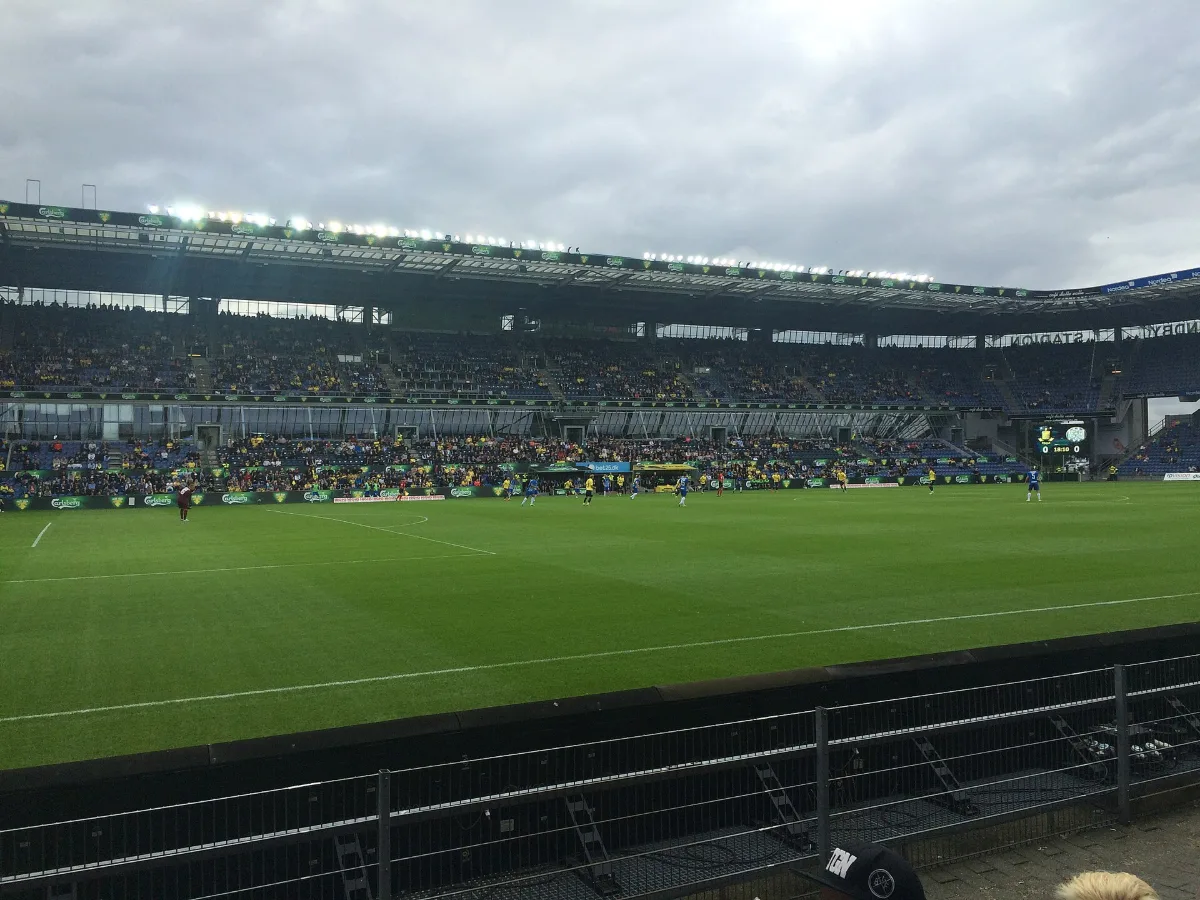
Brøndby have played at the same address since 1965, but the ground has grown up with the club. The first main stand — 1,200 seats — arrived in 1978, concrete terraces followed in 1982, and the athletics track was dug up in 1989–90 to add 2,000 seats.
In 1998 the club bought the stadium from the municipality for 23.5 million DKK and immediately spent double that modernising it. When Brøndby reached the 1998–99 Champions League the rebuild was still going, so those home European nights were played at Parken — the ground of their arch-rivals.
The redevelopment was finished in 2000: all four stands standardised to the same height, capacity around 29,000 for domestic games and roughly 22,000 all-seated for UEFA fixtures, making it Denmark's second-largest football ground.
The home end is the Faxe Tribunen on the south side, where the ultras group Alpha — founded in 2006 — organises the noise, the flags and the tifos.
Rivalry
Slaget om København
Brøndby's great fixture is against F.C. København — the Copenhagen derby, the biggest club match in Danish football and a fixture that splits the capital in two directions.
The lines are drawn between city and suburb. Brøndby are the Vestegnen club: blue-collar, western, self-made. F.C. København, formed in 1992 from the merger of KB and B 1903, are the capital's establishment. The clubs' duels in the 1990s and 2000s decided league titles season after season, and the atmosphere at Brøndby Stadion on derby day is generally considered the fiercest in the country.
The record crowd at the ground — 31,508, on 18 June 2003 — came against F.C. København. And when Brøndby won the title in 2021, F.C. København were the giants they had to climb over.
Derby day, in short
- RivalF.C. København
- FixtureThe Copenhagen derby
- IdentityVestegnen v the capital
- Biggest crowd31,508 (18 June 2003)
- Danger zoneNever mention 1992 to a Brøndby fan
Hall of fame
Legends of the Yellow and Blue
More than 500 players have worn the shirt since 1964, and the club has been shaped as much by the dugout, the boardroom and the training ground as by the pitch. These are the names that built Brøndby's reputation.
On the pitch
Bjarne Jensen
Defender · 1978–92
The club's record appearance-maker: 556 official games across 14 seasons, every one of them for Brøndby after joining the youth ranks as a boy in 1968. Five championships, a Danish Cup, twice the club's player of the year and Danish Player of the Year in 1988.
Kim Christofte
Sweeper · 1979–92
A Brøndby youth product who became the first player the club ever sold for a fee, when Lokeren came calling in 1981 — and who came back twice. Part of the first championship side in 1985 and of the 1990–91 European run, he converted the decisive penalty in the Euro 1992 semi-final shootout as Denmark went on to win the trophy.
Michael Laudrup
Forward · 1982–83 · Head coach 2002–06
The brightest talent in Danish football, handed his breakthrough at Brøndby at 18: 15 league goals, Danish Player of the Year, and the club's first national-team cap in 1982 before a record move to Juventus. He returned as head coach in 2002 and delivered the 2005 championship.
Kim Vilfort
Midfielder · 1986–98
Seventeen years, 470 official games and ten major titles — and a goal in Denmark's Euro 1992 final that came with his young daughter seriously ill back home. He stayed through the financial crisis and later ran the club's youth system, where his own sons also played.
Lars Olsen
Defender · 1986–91, 1995–98
A six-time Danish champion with Brøndby and the captain who lifted the trophy for Denmark at Euro 1992. He came back after the crisis to lead the side that won three championships in a row.
John “Faxe” Jensen
Midfielder · 1980s–90s
Fans' favourite, Euro 1992 champion with Denmark, and the driving force behind the mid-1990s rebuild that ended the club's post-crisis slump.
Peter Schmeichel
Goalkeeper · 1987–91
Four league titles in five seasons and the giant at the back of the 1990–91 European run. His form in that side earned a move to Manchester United, where he became one of the greatest goalkeepers the game has seen.
Bent “Turbo” Christensen
Striker · 1987–91
Nicknamed Turbo for his pace, he scored 116 goals in 208 games for Brøndby, finished as the Danish league's top scorer three times in four seasons, and was sold to Schalke in 1991 in a deal that made him the most expensive Danish footballer of his time.
Uche Okechukwu
Centre-back · 1990–93
Signed from Nigeria by the newly appointed Morten Olsen in July 1990, he was a mainstay of the side that won the 1990 and 1991 championships and reached the 1990–91 UEFA Cup semi-final, before a decade at Fenerbahçe.
Ole Bjur
Midfielder · 1991–2000
384 matches, three championships and two Danish Cups after arriving in July 1991, and a fixture on the right flank once Ebbe Skovdahl moved him to wing-back. He later returned to the club as sporting director from 2011 to 2013.
Mogens Krogh
Goalkeeper · 1991–2002
464 first-team games after he was signed to replace Schmeichel. In the 1995–96 run-in he charged forward for a corner and headed the equaliser against AGF that swung the title Brøndby's way.
Søren Colding
Right-back · 1993–2000
Joined in 1993 when his club went bankrupt, and went on to captain Brøndby from right-back. Club player of the year in 1996, a mainstay of the three titles in a row and the 1998–99 Champions League side, then six years with VfL Bochum.
Ruben Bagger
Winger · 1993–2007
Spotted by Tom Køhlert and signed in the summer of 1993, he spent all fourteen years of his professional career at Brøndby: more than 300 matches, five championships and three Danish Cups before retiring in December 2007.
Kim Daugaard
Midfielder · 1993–2008
A one-club midfielder with more than 450 games for Brøndby, five championships and five Danish Cups, and the club's player of the year in 1998. He signed his first professional contract in January 1993 alongside Allan Ravn.
Allan Ravn
Midfielder · 1993–2002
235 appearances and four championships — and, in the 1999 Champions League, a 92nd-minute solo winner against Bayern Munich, the individual highlight of his Brøndby career.
Per Nielsen
Defender · 1993–2008 · Women's team coach 2015–24
One club, 547 official games, five championships and three Danish Cups — and captain of Brøndby from 2002 until his retirement. He stayed in the game as a coach, spending three years in Brøndby's youth setup and four at Hvidovre before taking charge of Brøndby's women's team in 2015. Over nine seasons there he won the Danish women's league title in 2015, 2017 and 2019.
Dan Eggen
Centre-back · 1993–97
The Norwegian centre-half of the mid-1990s side, signed from BK Frem and a 25-cap international; he later played in the Alavés team that reached the 2001 UEFA Cup final.
Auri Skarbalius
Full-back · 1995–2005
Bought from Inkaras Kaunas for $150,000 after meeting Brøndby in Europe, he won three championships in a row and became a cult hero in the stands — he did not score his first goal for the club until the 2001–02 title season. He marked Beckham and Figo in the 1998–99 Champions League, and later coached at Brøndby.
Ebbe Sand
Striker · 1990s
An engineering student who turned up at the club and became a champion: 12 goals in his breakthrough season, then 28 in the 1997–98 Double year, as the spearhead of the three-in-a-row side before his move to Schalke.
Thomas Lindrup
Winger · 1996–2002
A wide player through the club's late-1990s golden run, in the squad for the three titles in a row and for the 2002 championship, before spells at OB, AGF and FC Nordsjælland. He has chaired the Danish players' association, Spillerforeningen, since 2006.
Mattias Jonson
Winger · 1999–2004
Brought in by Åge Hareide and converted from striker to left winger. He helped win the 2001–02 championship, scoring a hat-trick in a 5–0 win over AB, before moving on to Norwich City.
Dan Anton Johansen
Defender · 1999–2006
A Brøndby boy who debuted at 19 on 1 April 1999 and was the club's player of the year in 2000; he won the 2002 and 2005 championships before leaving for Lillestrøm in July 2006.
Thomas Kahlenberg
Midfielder · 2001–05, 2014–17
Thrown in as a teenager by Tom Køhlert during the 2001–02 title run. Two championships in his first spell, then France and Germany with Auxerre and Wolfsburg, before he came home to finish his career.
Martin Retov
Midfielder · 2002–08
More than 200 games after arriving from Køge, and the club's player of the year in 2004. He later spent years on the Brøndby bench as an assistant coach, including a spell as caretaker.
Morten Wieghorst
Midfielder · 2002–05
One of Michael Laudrup's first signings in 2002, a 2005 Double winner, and the man who played on with a blood-soaked head bandage and scored four goals in the 7–1 win over Farum BK in November 2002.
Johan Elmander
Striker · 2004–06
The Swedish forward was the creative spark of Michael Laudrup's 4–3–3 and was voted the club's player of the year as Brøndby won the 2004–05 Double. 22 league goals in 58 games, plus a second spell later on.
Teemu Pukki
Striker · 2014–18
Arrived on loan from Celtic in 2014 and signed permanently a year later. His goals — including a hat-trick that knocked Hertha BSC out of Europe in 2016 — earned him a move to Norwich, where he became a Premier League regular.
On the bench and behind the scenes
Per Bjerregaard
Player, then chairman · from 1973
A club captain and a doctor who took over as chairman at 27 and then spent decades running the club: building the professional Brøndby of the 1980s, driving the stadium redevelopment, and repeatedly steering it away from collapse.
Morten Olsen
Head coach · 1990–92
Appointed in 1990 and champion in each of his first two seasons. He is the coach who took Brøndby to the 1990–91 UEFA Cup semi-final, before going on to spend 15 years in charge of Denmark.
Ebbe Skovdahl
Head coach · 1990s
A former Brøndby player who built the most dominant Danish side of the decade: three championships in a row and the 1998 Double, plus the UEFA Cup nights against Liverpool and Karlsruher SC.
Tom Køhlert
Coach · on and off from 1979
The club's great youth developer, who led the first championship in 1985 and then kept coming back as caretaker to steer another title in 2002 and a Danish Cup in 2008. He handed Thomas Kahlenberg his debut.
Alexander Zorniger
Head coach · 2016–19
The German who gave the side its modern identity: an extreme form of gegenpressing the Danes christened overfaldsfodbold, “assault football”. It brought two runners-up finishes and the 2018 Danish Cup.
Niels Frederiksen
Head coach · 2019–22
The coach who ended the wait: on 24 May 2021 his Brøndby beat Nordsjælland 2–0 to win the club's 11th Danish championship and their first in 16 years.
John Ranum
Academy and club stalwart · over four decades at Brøndby
A veteran of the club with more than four decades of service, best known for his work with the youth teams and the under-19 side. Coaches who came through Brøndby's academy — among them Frederik Birk, later of the under-19s — count him among the most formative influences on their careers.
The stands
Sydsiden, tifo and fællesskab
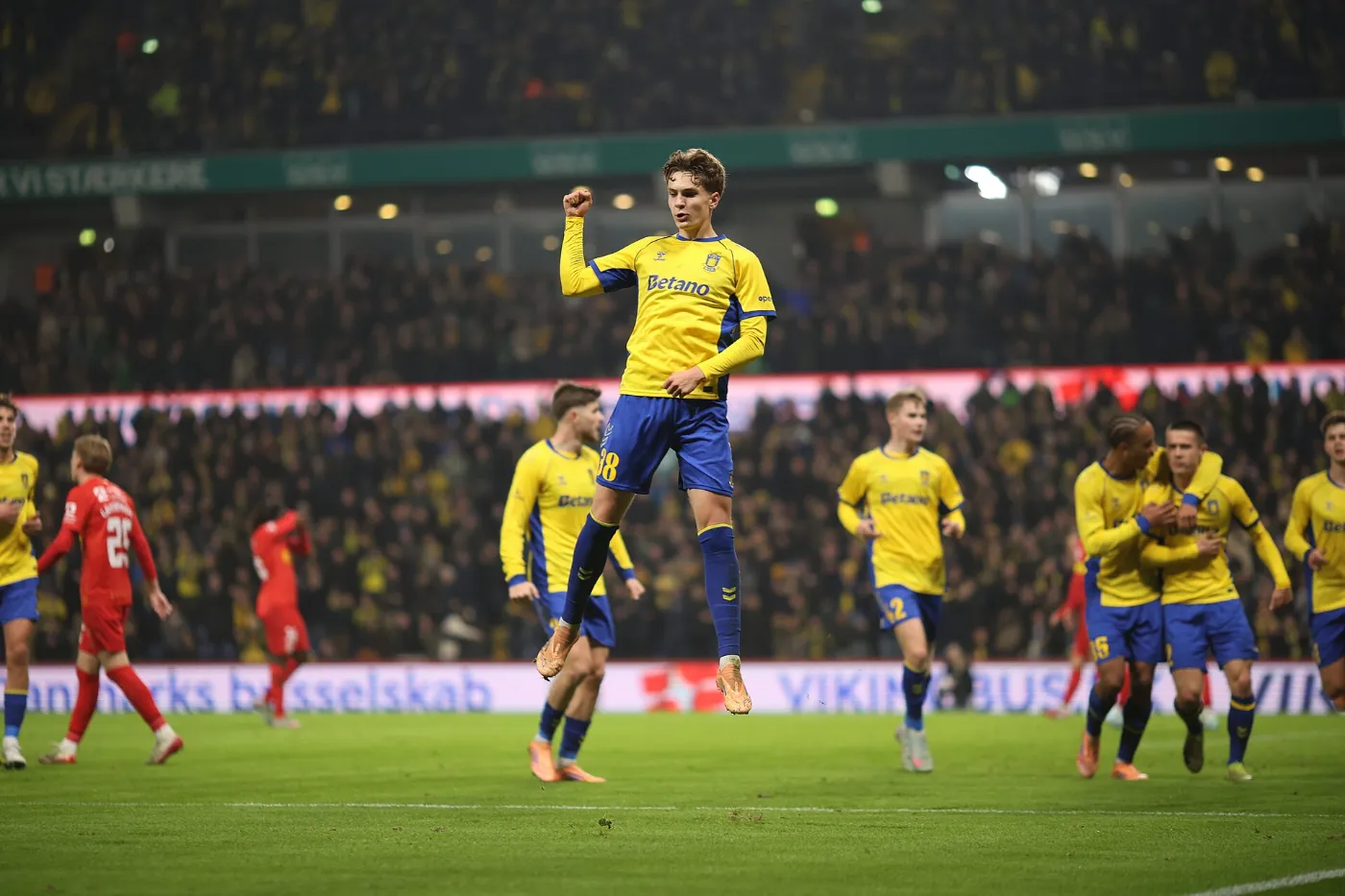
Brøndby's support is one of the reasons neutrals tune in. The club is renowned for its ultras scene, centred on the south stand and led since 2006 by the group Alpha, who organise the songs, banners and tifo displays. Around them sit Suburban Casuals, Southside United, Svinget, Deling 43 and Fri Sport.
The result is a stadium that behaves less like a modern arena and more like a terrace: continuous singing, huge two-pole flags, smoke on European nights. The club leans into it — its 2016 strategy was built around fællesskab, community, and the idea that the fans are the club's defining asset rather than its audience.
It is also a fanbase with a long memory. The 1992 financial crisis, the 2013 rescue, the 16-year wait for a title that ended in 2021 — all of it is part of the identity. Supporting Brøndby has rarely been comfortable, which is precisely the point.